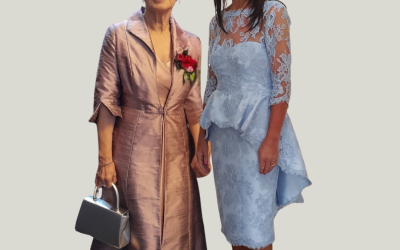
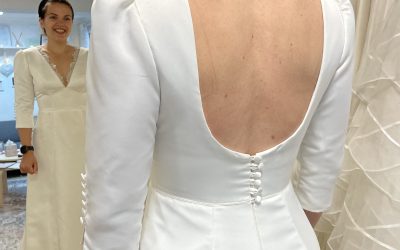
Bride & groom A&J. Image Paul Keppel Photography
Hello again! For new enquirers, I think it is useful to revisit how my bespoke wedding dress process works. This is the second post about my bespoke wedding dress design service, where I focus on patterns and toiles.
In my last post I talked about the initial design stage of the process. Here we will look at fittings. We need patterns and toiles to proceed to the fitting stage. It’s all very exciting and where your wedding dress or outfit starts to become a real garment in 3D.
Patterns and Toiles
What on earth is a toile, you ask? A toile is a mock-up or prototype of your design made in cheaper fabric. It is easy to manipulate and take alterations from, as well as to draw style lines and write notes upon. Typically this fabric is a cotton calico, but it can be something softer, such as a lining fabric or muslin. Anything that is affordable and that can usefully imitate the final fabric to a degree.

Bespoke Bride Anna during her 2nd calico toile fitting by Rachel Lamb Design
I always make toiles for your initial fittings. It is the most important stage of the process and where I test the pattern and get a precise fit for you. You also see the design taking shape without the commitment of it having been cut in the real fabric. During toile fittings we can both make changes to the fit and design in a cost effective way. It is an organic process and we work together on your design.
Measurements
I’m skipping ahead here though. In order to make a calico toile, in most cases I need to create a paper pattern first. When you confirm your booking with me, I take your measurements. This is a full set of detailed measurements of your body and of certain parts of the design. Once I have these, I create the first draft of a paper pattern of your design. It may be part of the design or the whole thing, depending on the style and features of your wedding dress. Ultimately as fittings progress, more of the design will be toiled.

Drafting a bespoke paper pattern

Initial paper pattern for a bespoke corset by Rachel Lamb Design
The first toile is made from your first pattern, and this is what you will put on in your first fitting.
Real Life Fittings
Here is bespoke bride Savanna in her early calico toiles fittings. You can see how I have tightened up the fit using pins, and drawn some style lines on the toile for boning channels.

Bespoke bride Savanna in her 1st calico toile fitting

Bespoke bride Savanna back view of her 1st calico toile fitting
And bespoke bride Tori in her 1st calico toile fitting:

Bespoke bride Tori in her first toile fitting

Bride Tori in her 2nd toile fitting
In all cases, there are a minimum of two calico toile fittings to check the fit and design. Sometimes there are more than two calico fittings. It all depends on the design being created. We keep going until it is right. Toiles are also useful for positioning motifs such as lace or embroidery, and confirming the size of certain features.

Bespoke bride Claire in her calico toile fitting
Once we are both satisfied with the toile stage, I cut out the wedding dress or outfit in the real fabrics and the fittings continue. More on this in the next post!
If you’re considering a bespoke wedding dress, I hope this has been helpful. To find out more or discuss your ideas, please do get in touch for a no obligation chat.